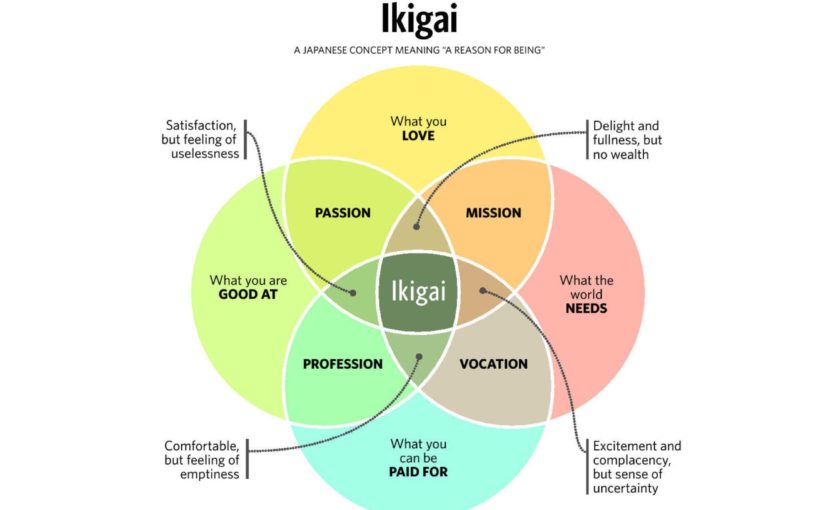
Ikigai is often translated as “a reason for being,” but that translation is too polite for the modern world. In contemporary society, especially in technology, ikigai is less about serene balance and more about tension: between passion and exhaustion, meaning and obsession, freedom and self-imposed pressure.
Originally rooted in Japanese culture, ikigai described the quiet intersection of what you love, what you are good at, what the world needs, and what sustains you. It was never meant to be a motivational poster. It was a lived equilibrium, shaped by community, rhythm, and restraint.
Modern life shattered that context.
Today, ikigai lives inside Slack notifications, Git commits, cloud dashboards, and endless learning curves. For IT professionals, ikigai doesn’t look like balance. It looks like absorption.
And if we are honest, many of us like it that way.
Ikigai in a Hyperconnected Society
In the modern knowledge economy, work is no longer just something we do. It is something we are. Especially in IT, the boundary between professional identity and personal identity has thinned to the point of near transparency.
We don’t simply work with technology. We think in systems, reason in abstractions, and see the world as architectures, flows, and constraints. This cognitive posture doesn’t switch off at 6 p.m. It follows us into conversations, hobbies, and late-night curiosity.
Ikigai, in this context, becomes the feeling of being mentally alive.
The modern society rewards this. It celebrates passion, hustle, mastery, and lifelong learning. At the same time, it quietly penalizes stillness. If you are not updating your skills, you are falling behind. If you are not curious, you are obsolete.
Ikigai today is not discovered. It is continuously compiled.
What Ikigai Means for IT Professionals
For people in IT, ikigai often emerges from problem-solving itself. The pleasure of untangling complexity. The satisfaction of elegant solutions. The quiet pride of systems that simply work.
This is not accidental. Technology work provides constant feedback loops. You build something, it either fails or succeeds. The dopamine is real. The sense of purpose is immediate.
That is why many IT professionals don’t need external motivation. We voluntarily spend evenings reading documentation, experimenting with side projects, or learning yet another paradigm that didn’t exist five years ago.
This is ikigai in its modern form: deep engagement with complexity that matters.
But here’s the uncomfortable truth.
Work-Life Balance vs. Work-Life Integration
Traditional discussions about work-life balance assume work is a burden that must be contained. For many in IT, that assumption is false.
We are not trying to escape our work. We are often trying to protect it from becoming meaningless.
The real issue is not balance. It is sustainability.
When work aligns with ikigai, the danger is not working too much. The danger is never stopping because stopping feels like loss of meaning. Burnout doesn’t arrive as stress. It arrives as emptiness, when the joy of building is replaced by obligation.
Ikigai does not mean infinite output. It means continuity. The ability to return to the work with curiosity intact.
That requires boundaries, not because work is bad, but because it is valuable.
Yes, We Are Addicted — and That’s Not Entirely Bad
Let’s say it plainly: many of us are a little addicted to work.
We like the intensity. We like the feeling of relevance. We like being needed. We like solving things that didn’t exist yesterday. This is not moral failure. It is a human response to meaningful challenge.
The problem is not the addiction itself. The problem is unconscious addiction.
Ikigai in the modern IT world means choosing this engagement deliberately. Knowing when the obsession feeds growth, and when it starts consuming the very curiosity that made the work meaningful in the first place.

A More Honest Ikigai
For IT professionals today, ikigai is not about perfect harmony. It is about alignment over time.
Doing work that matters.
Caring deeply without burning out.
Accepting that passion and discipline must coexist.
Understanding that loving your work does not excuse neglecting yourself.
Ikigai is not a destination. It is a practice.
And in a world built on code, systems, and relentless change, that practice may be the most important architecture we ever design.