Digital Sovereignty Requires a Technological Architecture
EMEA PUBLIC SECTOR SERIES
This article is part of the EMEA Public Sector series, exploring why data sovereignty has become a critical priority for governments and public institutions across Europe, the Middle East, and Africa. As regulatory pressure, geopolitical risk, and AI adoption reshape digital strategies, data sovereignty is emerging as a key pillar of modern public sector data platform architectures, enabling control, resilience, and trusted digital services.
For more than a decade, Europe has approached digital sovereignty primarily through regulation. Frameworks such as GDPR, data protection legislation, emerging AI regulation and cloud governance initiatives have shaped the policy landscape of the digital economy.
Europe has demonstrated remarkable leadership in defining the rules for the digital age. Yet regulation alone does not create technological sovereignty.
A deeper question is now emerging.
If Europe seeks genuine digital sovereignty, what will the technological foundations of that sovereignty actually look like?
From Regulation to Architecture
This is where the idea of the European Digital Stack becomes increasingly relevant.
Rather than focusing only on rules and compliance frameworks, the concept shifts the discussion toward the technological architecture required to support a sovereign digital ecosystem.
In practical terms, the European Digital Stack refers to the layered infrastructure that enables digital services across the continent, including:
- digital identity
- secure data exchange
- cloud infrastructure
- AI platforms
- trusted APIs
- digital payment infrastructures
Together, these layers form the operational backbone of Europe’s digital future.
The Foundations of the European Digital Stack
At the foundation of this vision are capabilities that Europe has already begun to develop.
Digital identity initiatives such as eIDAS aim to provide trusted identification across borders. Secure data exchange frameworks allow institutions and companies to collaborate while maintaining control over sensitive information.
Cloud infrastructure, increasingly deployed within European regulatory and operational frameworks, provides the computational backbone on which modern digital services operate.
But the stack does not stop there.
Modern digital ecosystems depend on interconnected technological layers. Trusted APIs enable secure interaction between systems. Digital payment infrastructures support cross-border economic activity. AI platforms provide the intelligence layer that transforms raw data into actionable insights.
What makes the European Digital Stack particularly significant is that it moves the conversation from policy to architecture.
Defining the European Digital Stack
Digital sovereignty cannot be achieved solely by regulating technology providers. It emerges from building an ecosystem in which the core technological building blocks are interoperable, trusted and governed according to European legal and institutional principles.
The EuroStack Vision
This shift in perspective is already visible in recent policy discussions.
The recently published EuroStack report proposes a comprehensive vision for rebuilding Europe’s digital ecosystem across all technological layers.
The challenge is substantial.
Today, around 80% of Europe’s digital infrastructure and technologies originate outside the continent. This creates structural dependencies on non-European providers and limits Europe’s ability to shape its own technological trajectory.
EuroStack proposes a different direction:
a European digital ecosystem built on interoperable digital building blocks, operated by European institutions, companies and public administrations.
To understand how such an ecosystem could emerge, it is useful to examine the components that would make up a European Digital Stack.
The Emerging European Digital Stack
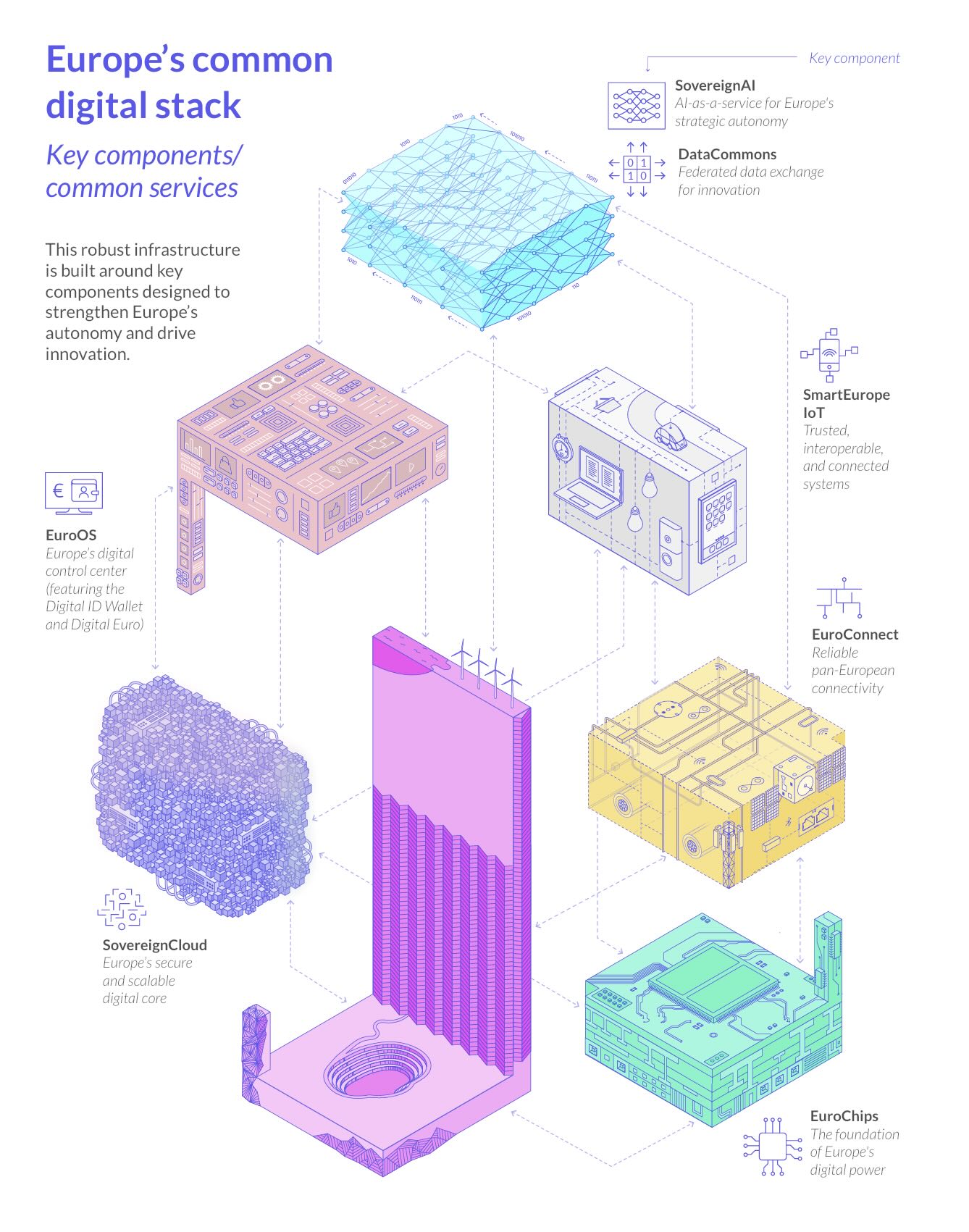
The EuroStack vision describes a layered digital environment composed of several critical capabilities:
- Digital identity systems enabling secure authentication across borders
- Secure data exchange frameworks allowing trusted information sharing
- Cloud infrastructure supporting scalable computing resources
- AI platforms providing advanced analytical capabilities
- Trusted APIs enabling interoperability between systems
- Digital payment infrastructures supporting cross-border economic transactions
Taken together, these layers form what could become a common European digital infrastructure.
At the core of this architecture lies a principle that has long defined European digital policy:
security by design and privacy by design.
Critical digital infrastructure must operate within European legal frameworks while guaranteeing strong protections for personal and institutional data.
Europe’s Digital Building Blocks
Importantly, this vision is not purely theoretical.
Several components of the European Digital Stack already exist.
Since 2014 the European Commission has been developing Digital Building Blocks under the Connecting Europe Facility programme. These are reusable technological components that Member States can adopt to implement interoperable digital services.
Among the most important components are:
- eID – cross-border digital identity systems
- EUDI Wallet – the upcoming European Digital Identity Wallet
- eSignature – legally recognised digital signatures across the EU
- eDelivery – secure cross-border data exchange infrastructure
- EBSI – the European Blockchain Services Infrastructure
These infrastructures already support hundreds of cross-border public sector use cases, including taxation, customs procedures, education and judicial cooperation.
A Concrete Example: The Once-Only Technical System
One of the most interesting implementations is the Once-Only Technical System (OOTS).
OOTS allows public administrations to exchange authentic documents such as birth certificates or business records across Member States without requiring citizens to repeatedly submit the same information.
Technically, OOTS combines several building blocks:
- eID for authentication
- eDelivery for secure data exchange
- interoperable APIs for cross-border services
The result is effectively a European public sector data space operating across national boundaries.
Digital Sovereignty Requires Data Platforms
Most discussions around EuroStack focus on cloud providers, semiconductor manufacturing or AI models.
These layers are undeniably important.
However, they often overlook a critical component of digital sovereignty: the data platform layer.
Every digital service ultimately depends on the ability to:
- store complex data structures
- manage evolving data models
- integrate data from multiple systems
- share data across jurisdictions
- power search, analytics and AI
In other words, digital sovereignty requires sovereign data architectures.
Without robust data platforms, digital infrastructures risk becoming fragmented and difficult to scale across borders.
The Role of Hyperscalers
A natural question arises.
If Europe aims to build its own digital stack, what role will hyperscale cloud providers play?
The reality is that Europe’s digital infrastructure will likely remain hybrid and multi-vendor.
Hyperscalers provide global scale, operational reliability and advanced compute capabilities. At the same time, European policy increasingly emphasises:
- jurisdictional control
- data portability
- vendor independence
- open standards
In this environment, the architecture of digital platforms becomes more important than the identity of the infrastructure provider.
Systems must be designed to remain portable, resilient and interoperable across multiple cloud environments.
The Importance of the Data Platform Layer
Modern public sector platforms are no longer simple databases supporting monolithic applications.
They must support:
- complex and evolving data models
- distributed architectures
- high-volume operational workloads
- integrated search and analytics
- real-time data processing
- AI-driven services
In this context, modern document-oriented data platforms have become increasingly relevant.
These platforms allow governments and public institutions to manage complex and evolving data structures while supporting distributed architectures and integrated analytical capabilities.
Platforms such as MongoDB Atlas illustrate this architectural approach by providing distributed, multi-cloud data services capable of operating across regions and jurisdictions while maintaining operational flexibility and avoiding infrastructure lock-in.
This architectural model aligns closely with Europe’s broader strategic objective of maintaining technological sovereignty while preserving openness and innovation.
Towards Sovereign Data Architectures
Digital sovereignty ultimately requires more than infrastructure investment.
It requires architectural choices that enable sovereignty by design.
These include:
- distributed data architectures
- multi-cloud deployment strategies
- open interoperability standards
- jurisdiction-aware data governance
- flexible data models capable of evolving with regulation
Europe has already demonstrated its ability to build interoperable digital public infrastructure through initiatives such as the Digital Building Blocks programme.
The next step is ensuring that these infrastructures are supported by data platforms capable of handling the scale and complexity of Europe’s digital ecosystem.
The Road Ahead
The EuroStack vision signals a new phase in Europe’s digital transformation.
Rather than focusing solely on regulation, Europe is beginning to build the technological foundations of its own digital ecosystem.
Digital Building Blocks demonstrate that shared infrastructure can operate across borders while respecting national governance frameworks. The next challenge lies in scaling these foundations into large-scale digital public infrastructures capable of supporting the entire European single market.
In this context, the future of European digital sovereignty will not depend solely on cloud providers or artificial intelligence models.
It will also depend on the design of the data platforms that power Europe’s digital public services.
The construction of the European Digital Stack is only beginning.
The architectural choices Europe makes today will shape the next generation of digital services across the continent.
And in many ways, the real architecture of Europe’s digital future will be decided not only in legislation, but in the design of the digital platforms that underpin its public and economic systems.