MongoDB Search is designed to be simple to use. From a developer’s point of view the experience is three steps: define an index, run a $search query, integrate the results. That simplicity is intentional, because it lets teams adopt full-text and vector search without introducing another system. From an architectural standpoint, though, the simplicity is built on top of a separate operational component, and that component is mongot.
Search is a distributed data layer
mongot indexes the data and executes the search queries, and it runs alongside mongod as a distinct process. That is a subtle but important shift: search is not just a database feature, it is part of a distributed data architecture, with everything that implies. Coordination between mongod and mongot, consistency of configuration across the two, resource allocation for indexing and query execution, network dependencies in containerised or hybrid environments. In small or controlled environments all of this stays transparent. As systems scale, it becomes the thing you are debugging.
In modern deployments, especially on Kubernetes or across hybrid infrastructure, the questions arrive in a predictable order. Is the search service actually connected to the database? Are the indexes fully synchronised and current? Is a resource constraint degrading performance? Are the configuration parameters the same across environments? Answering them usually means navigating several logs, distributed configuration and different runtimes, which is why observability of the search layer is a capability, not an optional extra.
A diagnostic in one command
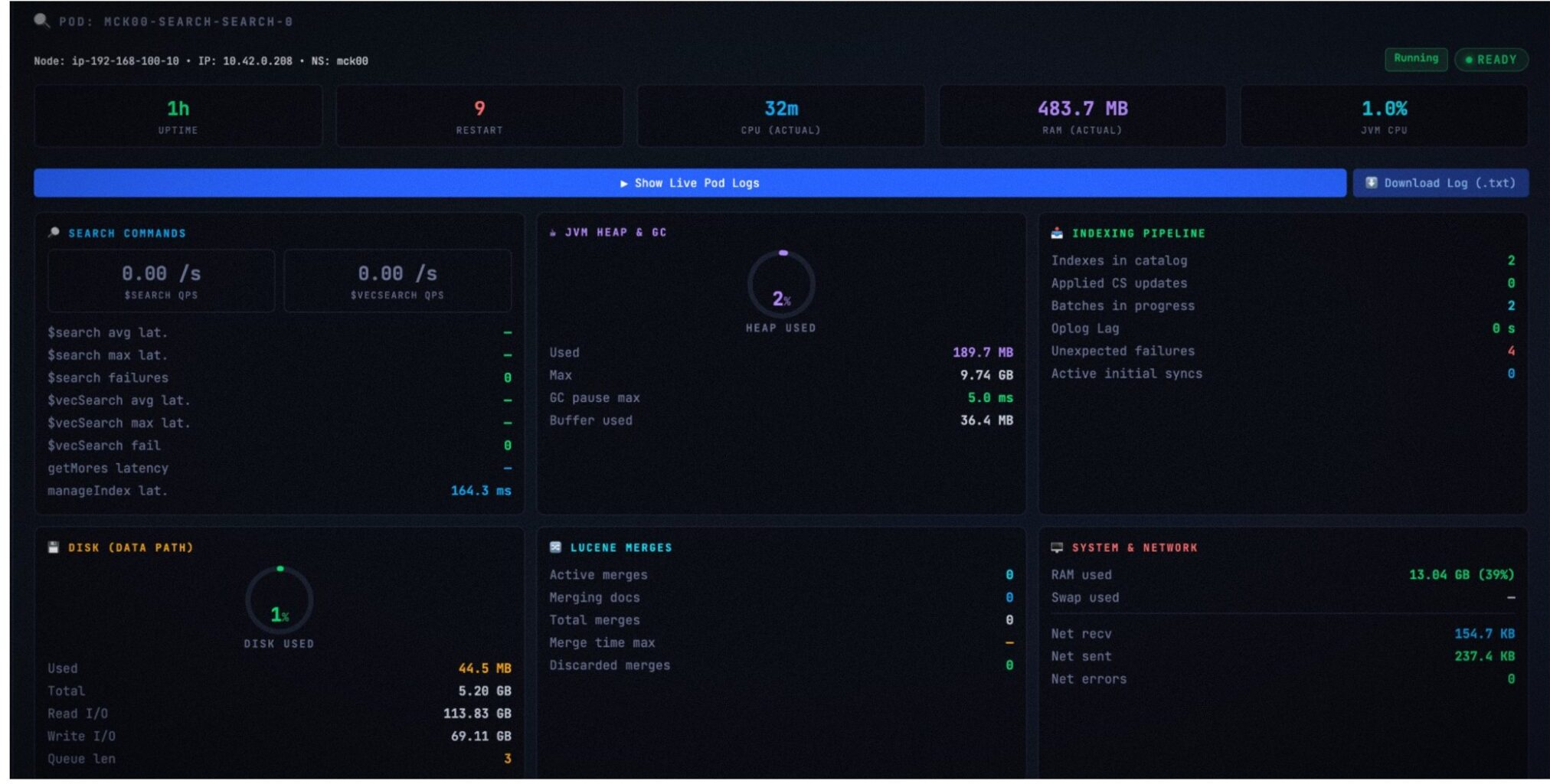
To make this practical, the approach is implemented in an open-source tool, mongot-doctor. Instead of correlating logs, metrics and configuration by hand, a single command produces a structured diagnostic:
mongot-doctor reportThe report consolidates three areas. Service health: whether mongot is running and reachable, and whether it can talk to mongod. Configuration coherence: the connection parameters, and whether the components agree with each other. Runtime signals: logs and operational data, with the anomalies that affect indexing or queries highlighted. The difference in practice is immediate. Before, multiple logs, distributed configuration and manual correlation across systems; after, one diagnostic report, clear visibility on service health and actionable findings in seconds. It is the difference between exploring a problem and diagnosing it, and it turns a fragmented troubleshooting process into a repeatable workflow that takes minutes rather than hours.
Where it matters
The approach earns its keep in three situations. Kubernetes deployments, where mongot runs in pods and operational visibility is distributed by construction. Hybrid architectures, where mongod and mongot may live in different environments, virtual machines on one side and containers on the other. And AI-driven workloads, where the accuracy and latency of vector search feed straight into application behaviour. In all three, understanding how the search layer behaves is a precondition for reliability.
The broader point is not about one tool. Modern data platforms need an extra layer of attention: not only how data is stored and how queries execute, but how each component is observed and diagnosed. Search in particular sits at the intersection of data, performance and user experience, and its reliability requires a deliberate approach to observability. MongoDB Search extends the database with powerful retrieval while keeping the developer experience simple; it also introduces an operational layer that deserves explicit consideration. Understanding that layer, and equipping teams to diagnose it, is a step toward production-grade systems rather than demos that happen to work.
This article builds on the work behind the mongot-doctor project, created to improve observability and diagnostics for MongoDB Search in real-world environments. Michele Farinacci, Advisor Solution Architect at MongoDB, shares practical insights from that experience.
Newsletter
Get the next essay before it goes out anywhere else.
New essays and each new field guide, by email. Free, no ads, one-click unsubscribe.
Field guides only? Choose your list.
-
 Essay · Technology Culture
Will AI Replace Programmers? What Three Waves of Automation Taught Me
No, and yes. AI will not replace the programmer; it is replacing most of what programmers spent their day typing. I have watched this happen twice before, at IBM and in the cloud years. Here is what changed each time, and what to do now.
-
Explainer · Data & AI
What Is an AI Agent, Really? Agentic AI Explained Beyond the Buzzword
An AI agent is software that pursues a goal by deciding, acting through tools and checking the result, in a loop. Most of what is sold as agentic AI is not that. Here is the test, and what makes agents work in production.
-
Essay · Data & AI
12 Books on Data and Power
Twelve books, eleven from Wired’s seasonal thirty plus one of my own, on how compute, data and the state became one conversation.
-
Essay · Technology Culture
Ocarina of Time Remake: Nintendo Is in the Memory Business
The remake lands on Switch 2 as a rapturous review and a holiday-quarter bet. Nintendo’s real product is a memory, re-embodied and resold.