Here is a super-SEO, premium rewrite of the post.
Same technical substance, cleaner structure, modern terminology, and written to rank while still feeling like a real engineer’s notebook, not marketing copy.
Connecting a SensorTag to the IBM Watson IoT Platform Using a Raspberry Pi as a Gateway
In an earlier experiment, I connected a SensorTag to the Watson IoT Platform using my MacBook as a temporary IoT gateway. That approach worked well for development, but it was never meant to be a production-style setup.
This post shows how to move one step closer to a real IoT architecture by using a Raspberry Pi as a dedicated Bluetooth Low Energy (BLE) gateway between the SensorTag and the cloud.
The goal is simple:
collect sensor data locally via BLE and publish it reliably to Watson IoT using Node.js.
Architecture Overview
The setup is intentionally minimal:
- SensorTag communicates via Bluetooth LE
- Raspberry Pi acts as the BLE gateway
- Node.js application reads sensor data and publishes it
- Watson IoT Platform ingests and visualizes telemetry
- Node-RED handles flows, dashboards, and integrations
This mirrors a common real-world IoT pattern: constrained devices, a lightweight edge gateway, and a managed cloud platform.
Using Node.js as the IoT Gateway Runtime
My Bluemix colleagues originally developed a Node.js application called iot-sensor-tag.
The app:
- Reads SensorTag data via Bluetooth LE
- Normalizes sensor values
- Publishes events to Watson IoT
Because it only requires Node.js and Bluetooth LE, it can run on anything that supports both, including a Raspberry Pi.
Preparing the Raspberry Pi for Bluetooth LE
Before running the application, the Raspberry Pi must be configured with a proper Bluetooth stack.
Download BlueZ
BlueZ is the official Linux Bluetooth protocol stack.
wget http://www.kernel.org/pub/linux/bluetooth/bluez-5.32.tar.xz
Installing Required Dependencies
Update the system and install the required libraries:
sudo apt-get install libglib2.0-0 libglib2.0-dev
sudo apt-get install libdbus-1-dev
sudo apt-get install libudev-dev
sudo apt-get install libical-dev
sudo apt-get install libreadline-dev
sudo apt-get install libusb-1.0-0-dev
These dependencies are required for Bluetooth LE support and proper system integration.
Configuring and Building BlueZ
Extract the archive and enter the directory:
tar -xf bluez-5.32.tar.xz
cd bluez-5.32
Run the configuration step:
sudo ./configure \
  --prefix=/usr \
  --mandir=/usr/share/man \
  --sysconfdir=/etc \
  --localstatedir=/var \
  --with-systemdsystemunitdir \
  --with-systemduserunitdir \
  --enable-library
Compile and install:
sudo make
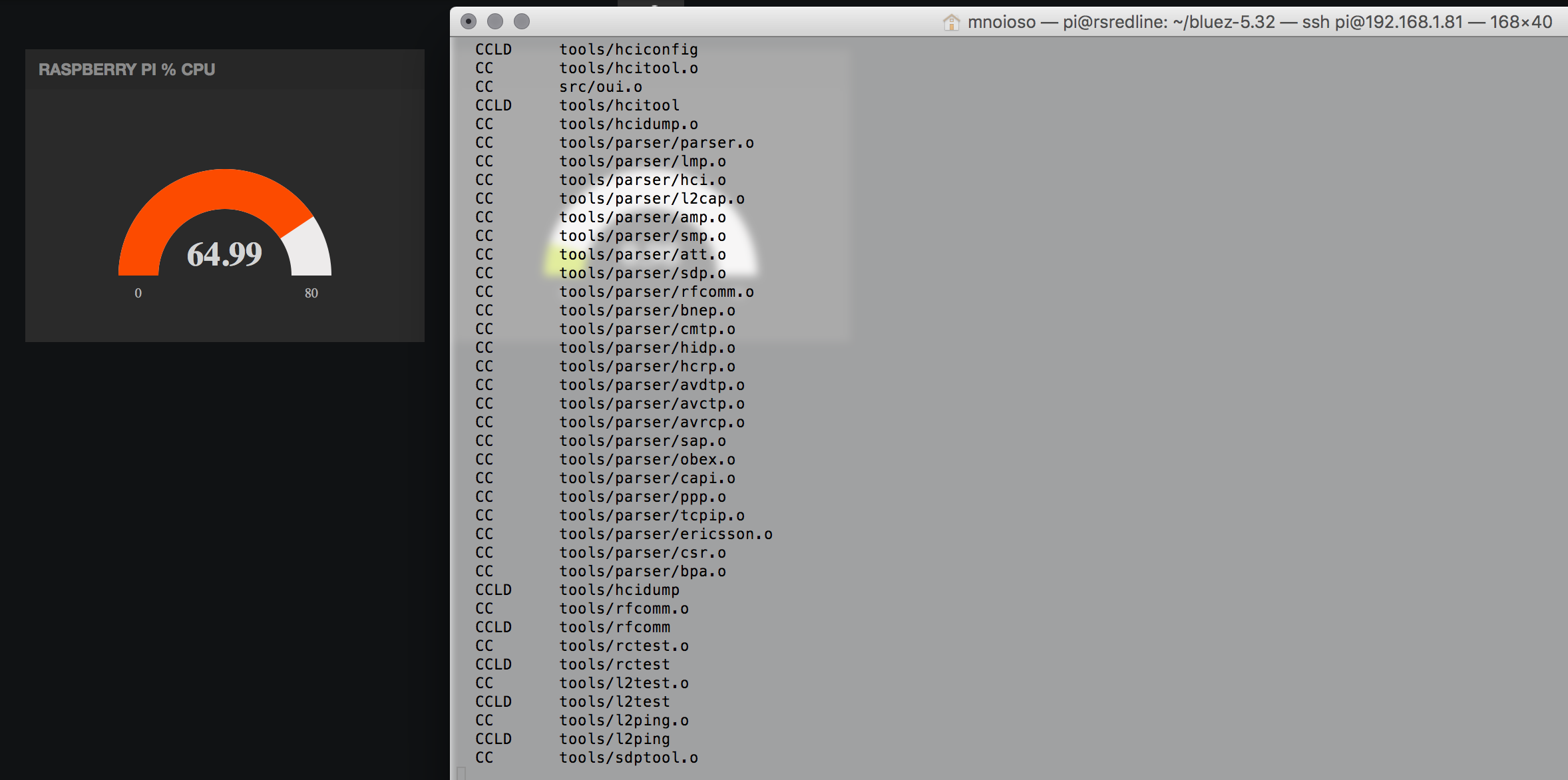
During the build, I monitored CPU utilization live from a Watson IoT dashboard.
Yes, the Raspberry Pi was already sending its own performance metrics to the platform while compiling Bluetooth drivers. Edge computing irony fully embraced.
Running the SensorTag Gateway Application
Once BlueZ is installed:
- Install Node.js on the Raspberry Pi
- Deploy the
iot-sensor-tagapplication - Start the Node.js process
At this point, the Raspberry Pi becomes a fully autonomous BLE-to-cloud gateway.
Registering the Device in Watson IoT
As with any Watson IoT setup:
- Register the Raspberry Pi as a device
- Configure authentication credentials
- Define event types and payload schema
Once registered, data flows naturally into the platform.
Visualizing Data with Node-RED
To complete the pipeline:
- Create a Node-RED flow
- Subscribe to SensorTag events
- Route data to dashboards, alerts, or storage
This turns raw sensor telemetry into something immediately observable and useful.
Final Thoughts
This setup replaces a laptop-based gateway with a low-power, always-on edge device, which is how IoT systems are meant to behave.
It is not flashy.
It is not complicated.
It is correct.
The architecture still holds.
Further Reading and References
- Raspberry Pi Official Documentation
Hardware setup, operating system configuration, and performance considerations for Raspberry Pi devices.
https://www.raspberrypi.com/documentation/ - Node.js Official Website
Runtime environment used to implement the SensorTag gateway application.
https://nodejs.org/ - Node-RED Documentation
Visual flow-based programming tool commonly used with Watson IoT for device orchestration and dashboards.
https://nodered.org/docs/ - TI SensorTag Overview
Technical overview of the Texas Instruments SensorTag, including supported sensors and BLE capabilities.
https://www.ti.com/tool/CC2650STK