From Proof of Concept to Operational Insight
During multiple on-site engagements with enterprise customers, I have repeatedly encountered the same challenge: traditional processes struggling to keep pace with modern operational complexity.
To address this gap, I built a series of targeted proof of concepts designed to demonstrate how computer vision and AI can transform well-known scenarios into intelligent, automated systems.
At the core of these experiments lies IBM Watson Visual Recognition, applied in a pragmatic, production-oriented way rather than as a theoretical exercise.
Use Cases Explored
The PoC focuses on applying visual recognition to scenarios that are common, measurable, and immediately valuable:
- Quality control
Automating visual inspection to reduce human error and accelerate validation processes. - Image classification
Structuring unlabelled visual data into meaningful, actionable categories. - Virtual receptionist
Enabling image-based interaction to support smart front-desk and access-control systems.
Fleet Damage Detection: A Concrete Example
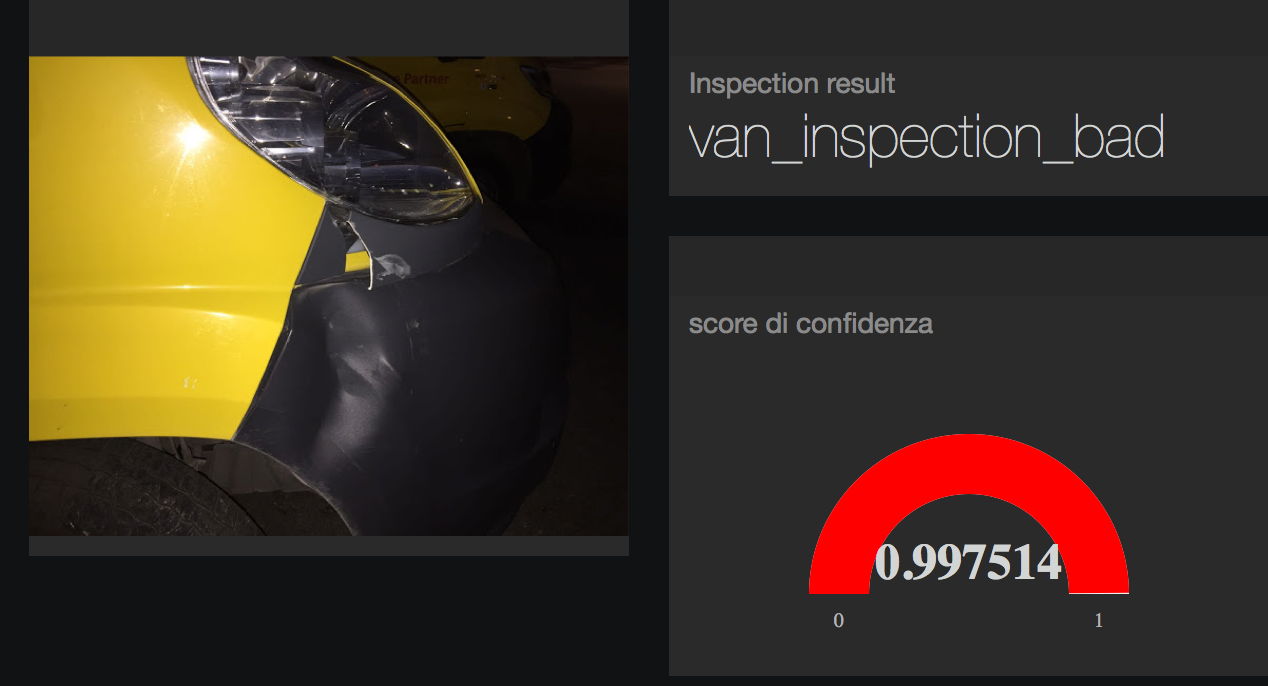
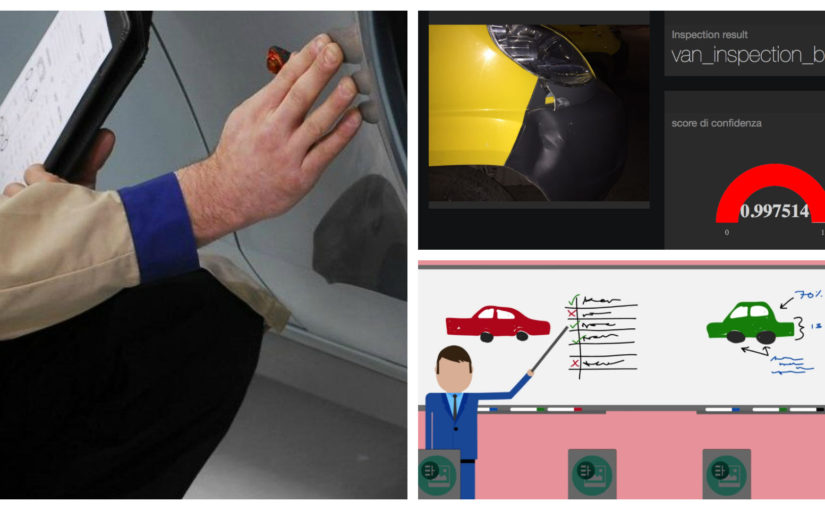
One of the most interesting scenarios under exploration involves automated inspection of fleet vehicles.
When a van or truck returns to a company hub, a camera system can automatically analyze its external condition. Using visual recognition, the system can detect:
- Scratches
- Dents
- Bodywork anomalies
- Visible damage acquired during operation
In this initial proof of concept, the model was intentionally kept simple to validate feasibility and accuracy:
- Two classification classes only
- Damaged vehicle
- Undamaged vehicle
- The damage class was trained exclusively on scratches and dents, allowing the model to focus on high-frequency, high-impact defects.
Despite its simplicity, the results clearly demonstrate how AI-driven inspection can reduce manual checks, improve consistency, and create a reliable audit trail for fleet management.
Architecture of the Proof of Concept
The PoC was built using a lightweight, modular stack to emphasize speed of iteration and clarity:
- Node-RED for orchestration and flow logic
- Freeboard for the real-time dashboard and visualization layer
- Watson Visual Recognition APIs for image analysis and classification
This approach allowed rapid experimentation while remaining close to architectures that enterprises can realistically adopt.
Live Demonstration
A working demo of the proof of concept was deployed directly on my Bluemix environment, showcasing the full flow from image acquisition to classification and visualization.
This experiment confirms a broader insight: visual recognition is no longer an experimental technology. When applied correctly, it becomes a practical tool for modernizing legacy processes and unlocking new operational intelligence.