Somewhere in a datacenter there is a switch for everything you remember digitally. Not a metaphorical switch: a change ticket, an approval chain, a runbook, a person on call. I have spent more than thirty years on the technical side of that arrangement, from IBM mainframes to the data platforms that European institutions run today, and I have learned that the most political object in any organization is not the org chart. It is the system that remembers.
Who Owns Memory Owns the Future began as a professional irritation. The question institutions ask me most often is where their data should live, as if geography were the whole of sovereignty. I learned to answer that residency is necessary and never sufficient. A dataset can sit in national territory and still be governed, in practice, by whoever controls the software that interprets it, the keys that encrypt it, the operator that administers it, and the skills that keep it alive. Lose any one of the four and the data is still yours on paper, and no longer yours in fact. At some point I realized this was not an argument about cloud contracts. It was an argument about the whole history of civilization, and nobody on my side of the machine room seemed to be writing it down.
Everyone quotes Orwell on this subject: who controls the past controls the future. The version I have watched from inside is quieter and, I think, more accurate.
You do not need to rewrite the past if you can decide how it will be remembered.
Nobody has to falsify an archive when they own the support it lives on, the format it is written in, the index that makes it findable, and the criteria by which it is retrieved. That kind of power leaves no fingerprints, because it looks like infrastructure. The book follows it across the whole arc: the fire circle where experience first became story and the elders who kept the flame became the first archive; the clay tablets that made power durable enough to survive its holders; the maps that made it administrable; the grids that fed it; the attention economy that turned our waking hours into contested territory; the datasets that promise to predict the future and, prediction by prediction, quietly narrow it.
The last two chapters are the reason I finally wrote it. This is the year machines began to remember our conversations: assistants that carry context from one exchange to the next, which means that somewhere there now exists a memory of how each of us thinks, and it has an owner, and the owner is not us. And at the far end of the arc there is Mars, which I use not as science fiction but as a limit case: a place where every human liberty, down to breathing, will depend on an infrastructure that someone designed, someone operates, and someone can switch off. Mars is not an exception to the story of memory and power. It is the story with the safety margins removed.
The shelf on technology and power is crowded, and I have read it with profit: the historians, the philosophers, the investigative journalists. What that shelf almost never contains is the view from inside the machine room, from the people who have designed these systems, defended them, migrated them at two in the morning, and occasionally shut them down for good. From inside, you notice different things. You notice that latency is a social hierarchy, because whoever is served answers first is served best. You notice that defaults govern more behavior than laws do. You notice that sovereignty is a property of architecture, not a location on a map. None of this is visible from the press box. All of it is visible from the console.
One disclosure, which is also on the first page of the book: I work for a database company. I wrote this as an architect, not as a vendor, and the reader will find no product in it. What the reader will find is the habit of mind my profession beats into you, which is to ask of every system not whether it is good or evil but where its dependencies run. The book distills that habit into five questions to ask of any system we depend on:
- Can we understand it?
- Can we contest it?
- Can we leave it?
- Can we correct it?
- Can we surprise it?
A system that lets you do all five is a tool. A system that fails them is an owner, whatever its terms of service say. Most of the systems I audit in my working life pass the first question with difficulty and rarely get further, which is worth knowing before we hand them the next fifty years of our collective memory.
I did not write a pessimistic book, because pessimism is just another way of surrendering the design decisions to someone else. Infrastructures of memory are built things, and built things can be built differently: with formats we can read, exits we can take, records we can correct, and enough slack for people to surprise the systems that claim to know them. But that only happens if the people who depend on these systems can see them clearly, and seeing them clearly has been, for thirty years, my job. The book is my attempt to hand over the map: where the supports are, where the switches are, and who, today, can reach them.
Because owning memory does not mean owning the future. It means deciding how much future is left for everyone else. That sentence took me a career to earn, and it is the reason this book exists.
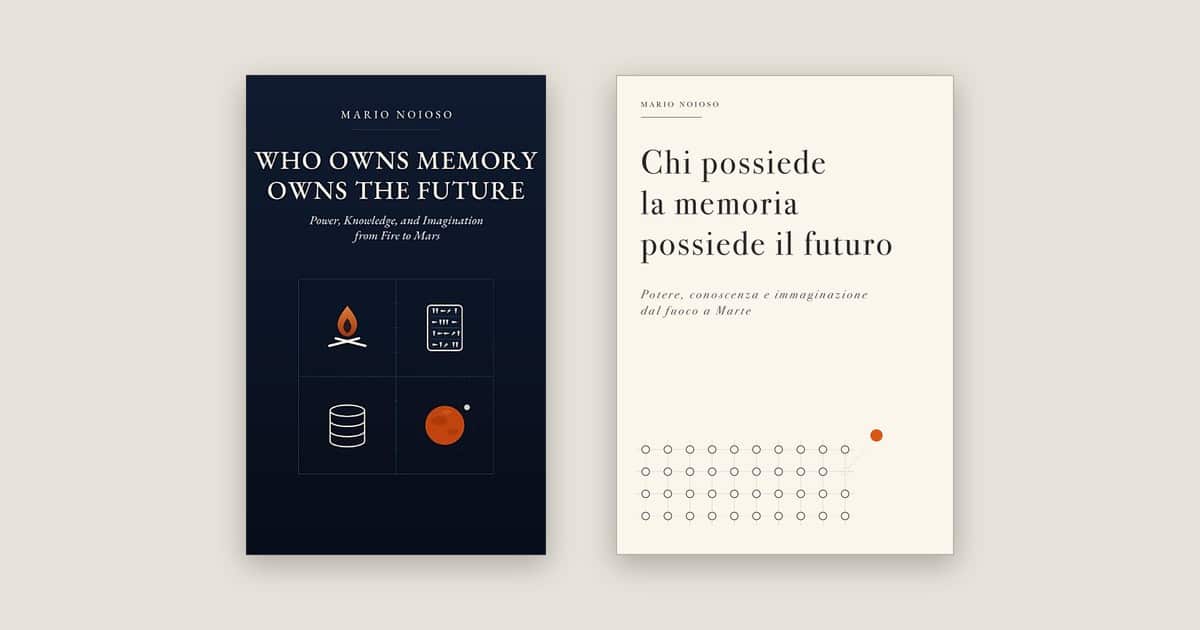
Who Owns Memory Owns the Future: Power, Knowledge, and Imagination from Fire to Mars is available in English on Google Play and in the original Italian on Amazon, paperback and Kindle. More about the book, including the Italian edition and the paperback to come, is on the book page.