A practical perspective on how MongoDB Search operates under the hood, and why observability becomes critical as architectures evolve.
The Search Layer, by Design
MongoDB Search is designed to be simple to use, while being powered by a dedicated search layer under the hood.
From a developer’s perspective, the experience is straightforward:
- define an index
- run a $search query
- integrate results into the application
This simplicity is intentional. It enables teams to quickly adopt full-text and vector search capabilities without introducing additional systems.
However, from an architectural standpoint, it is important to recognize that this simplicity is built on top of a separate operational component.
That component is mongot.
A Distributed Data Layer
mongot is responsible for indexing and executing search queries, operating alongside mongod as a distinct process.
This introduces a subtle but important shift:
- Search is not just a database feature
- It is part of a distributed data architecture
As a result, new dimensions emerge:
- coordination between mongod and mongot
- consistency of configuration across components
- resource allocation for indexing and query execution
- network dependencies in containerized or hybrid environments
In small or controlled environments, these aspects remain largely transparent.
As systems scale, they become relevant.
Why Observability Matters
In modern deployments, especially those involving Kubernetes or hybrid infrastructures, the search layer introduces additional operational complexity.
Typical questions start to arise:
- Is the search service correctly connected to the database?
- Are indexes fully synchronized and up to date?
- Are there resource constraints affecting performance?
- Are configuration parameters aligned across environments?
Answering these questions often requires navigating:
- multiple logs
- distributed configurations
- different runtime environments
This is where observability becomes a key capability, not an optional one.
A Practical Diagnostic Approach
To make this process more practical, this approach is implemented in an open-source tool: mongot-doctor.
Instead of manually correlating logs, metrics, and configurations, the tool provides a structured diagnostic in a single command:
mongot-doctor report
It consolidates service health, configuration coherence, and runtime signals into a single, actionable view.
In practice, the difference is immediate:
Before
- multiple logs
- distributed configurations
- manual correlation across systems
After
- a single diagnostic report
- clear visibility on service health
- actionable insights in seconds
This is the difference between exploring a problem and diagnosing it.
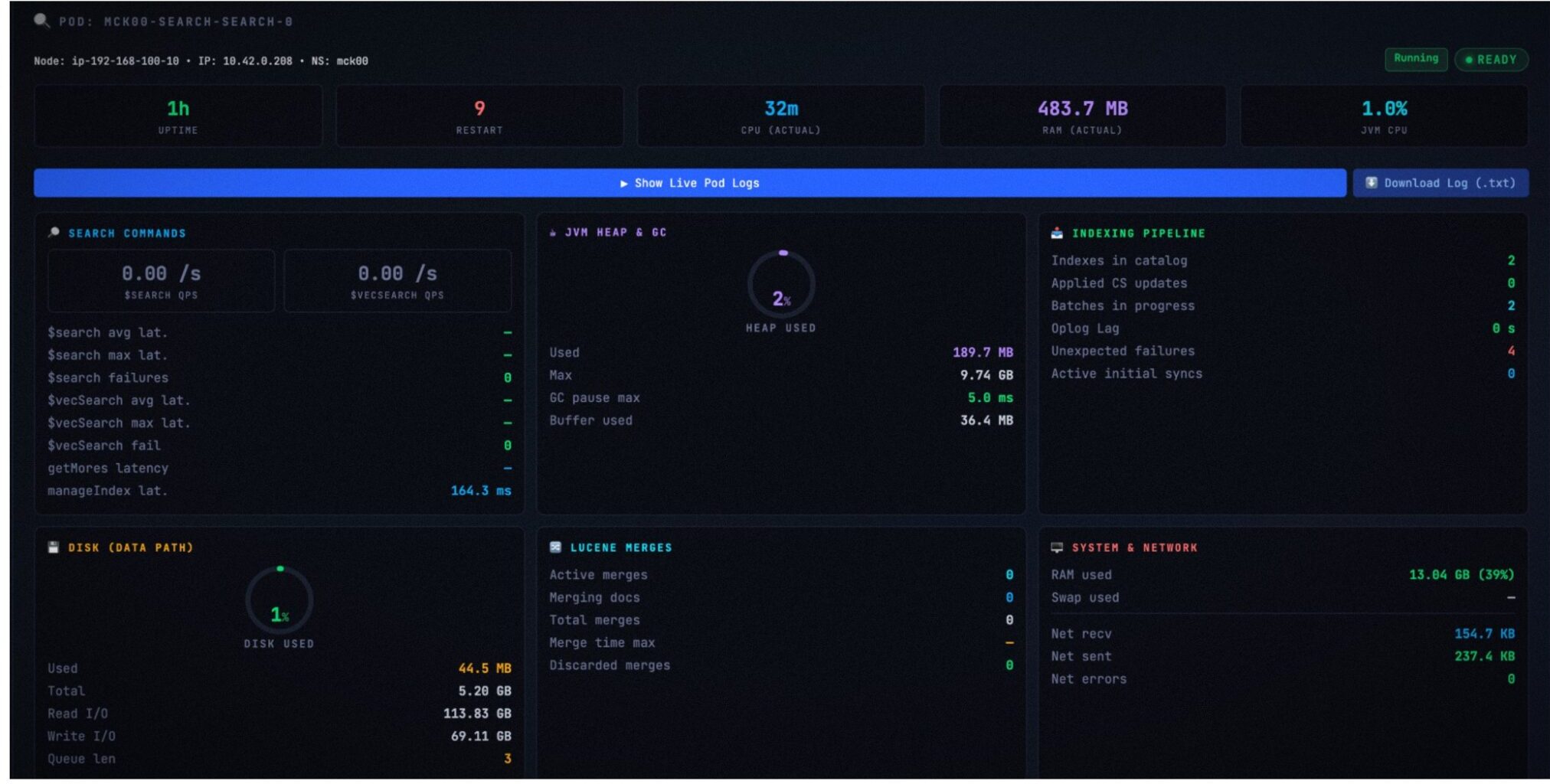
The tool directly addresses the diagnostic gap by consolidating three critical areas:
Service Health
- verifies that mongot is running and reachable
- checks connectivity with mongod
Configuration Coherence
- inspects connection parameters
- validates alignment between components
Runtime Insights
- collects logs and operational signals
- highlights potential anomalies affecting indexing or queries
By structuring these checks, the diagnostic process becomes more predictable and less dependent on manual investigation.
This is not just about simplifying operations.
It is about turning a fragmented troubleshooting process into a repeatable diagnostic workflow.
In practice, this means reducing troubleshooting time from hours to minutes, while providing a consistent and repeatable way to understand the state of the search layer.
Where This Becomes Relevant
This approach is particularly useful in scenarios such as:
Kubernetes-based deployments: where mongot runs in pods and operational visibility is distributed
Hybrid architectures: where mongod and mongot may run in different environments, such as virtual machines and containers
AI-driven workloads: where vector search accuracy and latency directly impact application behavior
In these contexts, understanding the behavior of the search layer is essential to maintaining system reliability.
From Capability to Practice
The broader takeaway is not limited to a single tool.
It is about recognizing that modern data platforms require an additional layer of attention:
- not only how data is stored
- not only how queries are executed
- but also how each component is observed and diagnosed
Search, in particular, sits at the intersection of data, performance, and user experience.
Ensuring its reliability requires a deliberate approach to observability.
Closing Thoughts
MongoDB Search extends the database with powerful retrieval capabilities while maintaining a simple developer experience.
At the same time, it introduces an operational layer that deserves explicit consideration.
Understanding how this layer behaves, and equipping teams with the right diagnostic tools, is a key step toward building reliable, production-grade systems.
Author
This article builds on the work behind the mongot-doctor project, created to improve observability and diagnostics for MongoDB Search in real-world environments. Michele Farinacci, Advisor Solution Architect at MongoDB, shares practical insights from this experience.