From Proof of Concept to Operational Insight
During multiple on-site engagements with enterprise customers, I have repeatedly encountered the same challenge: traditional processes struggling to keep pace with modern operational complexity.
To address this gap, I built a series of targeted proof of concepts designed to demonstrate how computer vision and AI can transform well-known scenarios into intelligent, automated systems.
At the core of these experiments lies IBM Watson Visual Recognition, applied in a pragmatic, production-oriented way rather than as a theoretical exercise.
Use Cases Explored
The PoC focuses on applying visual recognition to scenarios that are common, measurable, and immediately valuable:
- Quality control
Automating visual inspection to reduce human error and accelerate validation processes. - Image classification
Structuring unlabelled visual data into meaningful, actionable categories. - Virtual receptionist
Enabling image-based interaction to support smart front-desk and access-control systems.
Fleet Damage Detection: A Concrete Example
One of the most interesting scenarios under exploration involves automated inspection of fleet vehicles.
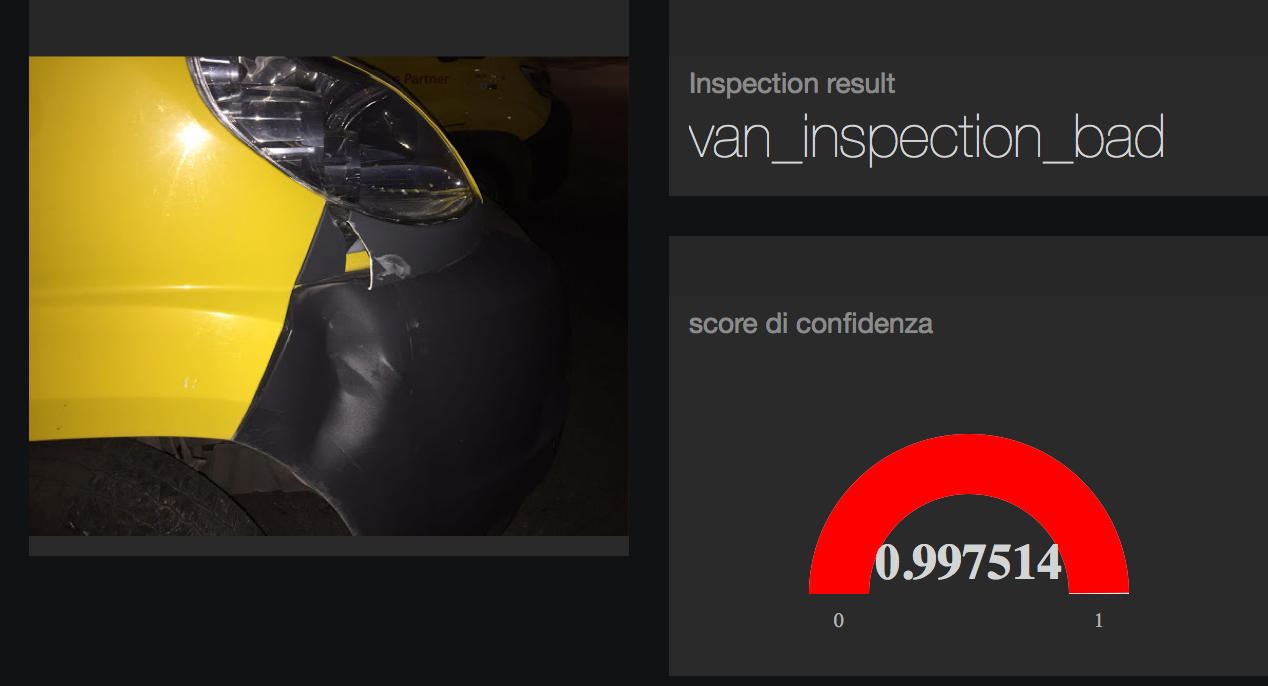
When a van or truck returns to a company hub, a camera system can automatically analyze its external condition. Using visual recognition, the system can detect:
- Scratches
- Dents
- Bodywork anomalies
- Visible damage acquired during operation
In this initial proof of concept, the model was intentionally kept simple to validate feasibility and accuracy:
- Two classification classes only
- Damaged vehicle
- Undamaged vehicle
- The damage class was trained exclusively on scratches and dents, allowing the model to focus on high-frequency, high-impact defects.
Despite its simplicity, the results clearly demonstrate how AI-driven inspection can reduce manual checks, improve consistency, and create a reliable audit trail for fleet management.
Architecture of the Proof of Concept
The PoC was built using a lightweight, modular stack to emphasize speed of iteration and clarity:
- Node-RED for orchestration and flow logic
- Freeboard for the real-time dashboard and visualization layer
- Watson Visual Recognition APIs for image analysis and classification
This approach allowed rapid experimentation while remaining close to architectures that enterprises can realistically adopt.
Live Demonstration
A working demo of the proof of concept was deployed directly on my Bluemix environment, showcasing the full flow from image acquisition to classification and visualization.
This experiment confirms a broader insight: visual recognition is no longer an experimental technology. When applied correctly, it becomes a practical tool for modernizing legacy processes and unlocking new operational intelligence.
Newsletter
Get the next essay before it goes out anywhere else.
New essays and each new field guide, by email. Free, no ads, one-click unsubscribe.
Field guides only? Choose your list.
-
 Book · Technology Culture
What Kirkus Reviews Said About My Book, Including the Part I Agree With
Kirkus Reviews has read Who Owns Memory Owns the Future and filed its verdict: Get It. The praise is welcome. The criticism is the more useful half.
-
Essay · Technology Culture
Will AI Replace Programmers? What Three Waves of Automation Taught Me
No, and yes. AI will not replace the programmer; it is replacing most of what programmers spent their day typing. I have watched this happen twice before, at IBM and in the cloud years. Here is what changed each time, and what to do now.
-
Explainer · Data & AI
What Is an AI Agent, Really? Agentic AI Explained Beyond the Buzzword
An AI agent is software that pursues a goal by deciding, acting through tools and checking the result, in a loop. Most of what is sold as agentic AI is not that. Here is the test, and what makes agents work in production.
-
Essay · Data & AI
12 Books on Data and Power
Twelve books, eleven from Wired’s seasonal thirty plus one of my own, on how compute, data and the state became one conversation.